Will Your Phone Work in the Yukon Backcountry? A Guide to Staying Connected

Your smartphone may work perfectly well when you land in Whitehorse, but conditions can change dramatically once you travel into a remote hunting concession. Beyond established communities and some highway corridors, conventional mobile coverage becomes increasingly limited, and many wilderness camps have no cellular service at all.
Preparing for a Yukon hunting expedition means understanding the difference between mobile coverage, satellite communication and the functions your phone can perform without an internet connection. With the right preparation, you can stay in touch with family, access essential information and manage your devices without expecting the same connectivity you have at home.
Where Mobile Phones Work in the Yukon
Mobile service in the Yukon is concentrated around communities and certain transportation corridors. Large stretches of wilderness remain outside conventional cellular coverage, including many areas used for guided hunting expeditions.
The Government of Yukon advises wilderness travellers to prepare for limited communication options rather than relying exclusively on mobile phones.
Connectivity in Whitehorse and other communities
Whitehorse generally offers reliable mobile coverage in populated areas, along with internet access at many hotels, restaurants and public facilities. Other communities, including Dawson City, Watson Lake and Haines Junction, also have cellular services, although coverage and network performance vary by location and provider.
Before travelling, check your mobile carrier’s coverage map and confirm whether your existing plan includes service in the Yukon.
Coverage maps are useful planning tools, but they do not guarantee reception at every location. Mountains, valleys and distance from telecommunications infrastructure can affect signal strength even within areas shown as covered.
Why remote camps are different
A hunting camp reached by bush plane may be located well beyond the nearest mobile tower. Even a camp relatively close to a highway can lack usable reception if surrounding terrain blocks the signal.
Switching mobile providers will not necessarily solve the problem when there is no conventional cellular infrastructure nearby.
Some newer smartphones support satellite-based features, and satellite-to-mobile services are developing in Canada. However, availability depends on your device, provider, subscription and location. These services should not be assumed to provide ordinary mobile coverage or unrestricted internet access.
The safest planning assumption is that conventional cell service will be unavailable throughout your time in a remote camp, unless your outfitter confirms otherwise.
Your Phone Can Still Be Useful Without Cell Service
Losing cellular coverage does not make a smartphone useless. Many of its most practical functions can operate independently of an internet connection, provided you prepare the device before leaving town.
Offline maps and downloaded documents
A smartphone’s GPS receiver can generally determine your location without cellular service. However, the mapping application needs access to previously downloaded maps to display useful geographical information.
Download detailed offline maps covering your destination and surrounding areas before departure. Depending on your application, these may include topographic information, elevation contours and geographical landmarks.
Keep offline copies of your itinerary, hunting-related documents, insurance details and emergency contacts. Remember that saving a bookmark to a website is not the same as downloading its contents.
Test everything in airplane mode before leaving Whitehorse. Discovering that an application requires an internet connection to open a particular document is considerably less convenient once you are in camp.
Photography, journals and personal records
A smartphone remains useful for photographing landscapes, documenting your expedition and keeping a personal journal.
You can record weather observations, keep notes about your experiences and organize photographs without being connected to a mobile network.
Automatic cloud backups, however, will generally have to wait until you regain internet access. Make sure your device has enough available storage before departure, particularly if you intend to capture high-resolution photographs or video.
Downloaded books, podcasts and audio
Downloading a few books or podcasts before departure is particularly worthwhile when preparing for quiet days in camp, when poor weather may limit outdoor activity.
Audiobooks, offline puzzles and downloaded music provide entertainment without requiring an active connection. Check whether subscription-based applications require periodic online verification, especially if your expedition lasts several weeks.
A paperback book is also worth considering. Unlike a smartphone, it does not compete with your communication equipment for charging time.
Satellite Communication Options Explained
Satellite communication can help bridge the gap between populated areas and remote wilderness, but different technologies serve different purposes.
A device designed to transmit emergency distress signals is not necessarily suitable for keeping in touch with family. Similarly, a satellite messenger capable of sending short text messages is not equivalent to a satellite internet connection.
| Technology | Primary purpose | Main limitation |
|---|---|---|
| Mobile phone | Everyday calls, messages and internet access | Conventional functions depend on cellular or Wi-Fi coverage |
| Satellite messenger | Short messages, location sharing and supported emergency functions | Subscription, battery power and satellite visibility |
| Satellite phone | Voice communication beyond cellular networks | Network coverage, equipment cost and power requirements |
| Personal locator beacon (PLB) | Emergency distress alerts | Not designed for routine communication |
| Satellite internet | Internet access at equipped locations | Requires compatible equipment, power and service availability |
Satellite messengers
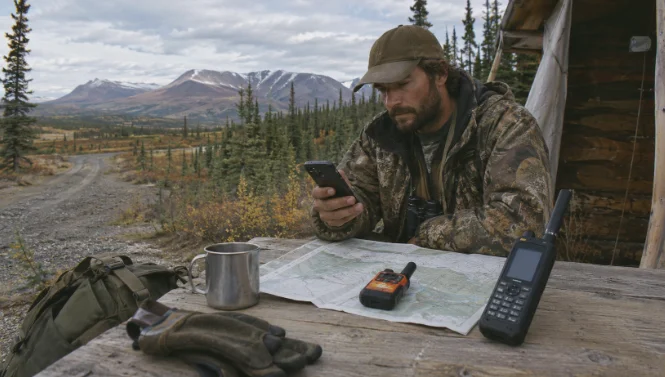
Devices such as Garmin inReach and ZOLEO provide satellite-based messaging and supported emergency SOS functions beyond conventional cellular coverage.
Their main advantage for a remote expedition is the ability to exchange short messages without needing a full internet connection. This may be sufficient for confirming your arrival, updating family members or communicating changes to your expected return date.
Depending on the model, some functions are available directly on the device, while others require pairing with a smartphone.
When comparing devices, consider subscription costs, standalone functionality, battery performance and whether your intended location falls within the satellite network’s coverage area.
Satellite phones and personal locator beacons
A satellite phone can be useful when voice communication is necessary, although performance depends on the network and surrounding terrain.
A personal locator beacon serves a different purpose. It transmits a distress alert intended for search and rescue authorities rather than providing everyday messaging. Canadian-coded 406 MHz beacons should be registered with the Canadian Beacon Registry, which maintains information that can assist emergency responders.
Parks Canada recommends carrying appropriate satellite communication equipment when travelling through remote areas of Kluane National Park and Reserve, where ordinary mobile phones are out of range across much of the park.
Can you rely on your smartphone’s satellite features?
Not necessarily. Northern latitude is a particularly important consideration in the Yukon.
Apple advises that satellite connectivity on compatible iPhones may not work reliably above 62 degrees north. Other satellite-to-mobile services may have geographical restrictions that exclude parts of northern Canada.
These limitations illustrate why a feature advertised as available in Canada may not be available throughout the country’s northern territories.
Check the current geographical limitations of your specific device and service before relying on them for wilderness communication.
Does a Guided Hunting Camp Provide Internet Access?
Some Yukon hunting camps offer satellite internet, while others provide only limited emergency communications. There is no universal standard across outfitters or concessions.
Communications arrangements are one of several practical considerations covered in our guide to what to expect on a remote fly-in hunt.
Base camps versus spike camps
An established base camp may have permanent cabins, solar panels, a generator and satellite internet equipment. Depending on the outfitter, guests might have opportunities to send messages, check email or make internet-based calls.
A spike camp is typically a smaller, temporary camp established farther into the wilderness. Facilities are generally more limited, and ordinary internet access may be unavailable.
Even within a single concession, connectivity can vary significantly between camps. The internet access available at the outfitter’s main lodge may have little bearing on the facilities at the camp where you actually spend most of your expedition.
Questions to ask before your departure
Rather than simply asking whether a camp has Wi-Fi, establish what that access actually means:
- Is internet access available at your specific camp?
- Is it available continuously or only when power is running?
- Can guests use it, or is it reserved for operational communications?
- Will part of the expedition take place at a different camp?
- Does your guide carry an emergency communication device?
- Can you recharge personal devices during your stay?
A camp with satellite internet is not necessarily a place where you can remain available for work calls, stream video or maintain regular contact with people at home.
If reliable connectivity is essential because of family or professional responsibilities, discuss those requirements with your outfitter before booking.
How to Prepare Your Phone Before Leaving Whitehorse
The final evening in Whitehorse is a good opportunity to check your devices while you still have dependable internet access. Larger downloads, equipment purchases and satellite subscription arrangements are better handled well before your trip.
Complete the following tasks before heading into the backcountry:
- Download offline topographic maps covering your destination.
- Save your itinerary, booking confirmations and essential documents locally.
- Store emergency contacts and your outfitter’s telephone numbers.
- Download books, podcasts and other offline entertainment.
- Update communication and mapping applications.
- Activate and test any satellite communication subscription.
- Confirm that your designated contacts can receive satellite messages.
- Disable unnecessary automatic downloads and background updates.
- Check available storage space for photographs and videos.
- Test essential applications with cellular data and Wi-Fi disabled.
If you use applications that require account authentication, make sure you are already signed in. Some services may require additional verification if you attempt to access them after a long period offline.
Keep a paper copy of essential contact information and your itinerary as a backup. A damaged or discharged phone should not leave you without access to important details.
Keeping Batteries Alive During a Remote Trip
Reliable access to electricity can be as significant a challenge as finding a communication signal. A smartphone that lasts an entire day at home may behave differently during an extended expedition in cold conditions.
Cold weather and battery performance
Low temperatures can temporarily reduce lithium-ion battery performance. During colder September and October mornings, a phone or satellite communicator may discharge more quickly or temporarily stop functioning.
Keep essential electronic devices protected from prolonged exposure to cold and moisture. Follow manufacturer guidance regarding operating and charging temperatures, particularly when temperatures approach or fall below freezing.
Avoid leaving communication devices exposed to cold conditions overnight when suitable protected storage is available.
Charging arrangements at camp
Established cabins may provide generator or solar power, but charging opportunities can be more limited at temporary camps.
A portable power bank can provide additional flexibility, provided it meets the transportation requirements of your commercial airline and charter operator.
When estimating your charging needs, account for conversion losses rather than assuming that a power bank’s advertised capacity translates directly into a specific number of full phone charges.
Also consider how frequently you will use each device. Occasional messaging and photography generally require less energy than continuous navigation, video recording or frequent screen use.
Prioritizing essential devices
A useful approach is to divide electronic equipment into three categories.
| Priority | Examples |
|---|---|
| Essential | Emergency communicator, primary navigation equipment and headlamp |
| Useful | Smartphone, camera and supplementary GPS device |
| Optional | Tablet, wireless speakers and dedicated entertainment devices |
When charging opportunities are limited, essential communication and safety equipment should take priority over entertainment.
Airplane mode, reduced screen brightness and disabled background synchronization can help conserve smartphone battery power. Enable Bluetooth or other connections when required by your satellite communication device, and maintain any emergency functions needed for your trip.
Agreeing on a Communication Plan With Family
The most effective communication plan is one that everyone understands before you leave.
Family members accustomed to receiving immediate replies may become concerned when several hours pass without a message. During a Yukon expedition, however, terrain, weather, daily activities and limited charging opportunities can all affect communication.
AdventureSmart encourages wilderness travellers to leave a trip plan with a responsible person who understands when and how to respond if the traveller becomes overdue.
For a guided hunting expedition, an illustrative communication plan might include:
- Confirmation that you have arrived safely in Whitehorse.
- A message before departing for the remote camp.
- Routine check-ins every one or two days, where conditions permit.
- Written contact details for your outfitter and their office.
- An expected return date, an agreed overdue deadline and clear escalation instructions.
- Confirmation when you return to Whitehorse.
A missed routine check-in does not automatically indicate an emergency, but it should be handled according to the agreed plan. If the overdue deadline is reached without confirmation of your safety, your designated contact should follow the escalation instructions and contact emergency services as appropriate.
Known or suspected emergencies should be reported immediately rather than waiting for the next scheduled check-in.
Before leaving, confirm the appropriate emergency contact numbers and dialling procedures for your communication device. Some satellite phones cannot connect directly to three-digit emergency numbers, making advance preparation particularly important.
What Technology Cannot Replace
Satellite communication has made remote wilderness travel more connected than it once was, but no device eliminates the consequences of distance, difficult terrain or severe weather.
An emergency message can alert responders, but it cannot guarantee an immediate evacuation. Aircraft availability, visibility and local conditions may affect how quickly assistance can reach a remote location.
A smartphone cannot replace appropriate wilderness preparation, local knowledge, navigation skills or the professional judgement of your guide.
For most visitors, the sensible approach is to prepare a phone for offline use, confirm the communication arrangements provided by the outfitter and carry an appropriate independent means of emergency communication.
Once those essentials are in place, there is little reason to spend an expedition searching for a signal. Part of the appeal of the Yukon is the opportunity to spend time somewhere that does not demand constant connectivity.