Planning a Fly-In Yukon Hunt: From Whitehorse to Camp and Back

Booking a guided Yukon hunt is only the beginning of organizing a northern wilderness expedition. Between leaving home and arriving at a remote hunting camp, you may travel on commercial aircraft, spend several nights in Whitehorse, transfer to a regional staging point and board a bush plane carrying everything you will need for the next ten days or longer.
Unlike a conventional outdoor holiday, where accommodation and transportation can usually be rearranged independently, a fly-in hunt involves several connected arrangements. Understanding how those arrangements work, where delays can occur and which responsibilities belong to you or your outfitter makes the entire expedition considerably easier to manage.
What a Fly-In Yukon Hunt Actually Involves
A fly-in Yukon hunt is a guided hunting expedition in which aircraft provide access to a remote outfitting concession or hunting camp. Depending on the location, the aircraft may land on a wilderness lake, river or remote airstrip.
The flight into camp is often just one stage of a longer journey. Some expeditions involve additional travel between an established base camp and smaller temporary camps elsewhere in the concession.
Why road access is not always an option
The Yukon covers an enormous area, much of which has no permanent road access. Although highways connect several communities, many mountain ranges, river valleys and wilderness areas remain inaccessible by conventional vehicles.
For commercial big-game outfitting, the territory is divided into designated concessions. Registered outfitters hold exclusive commercial guiding rights for non-resident hunters within their respective areas.
The Government of Yukon requires non-resident big-game hunters to hunt with an outfitter or, where eligible, a licensed special guide. Canadian citizenship alone does not establish Yukon residency for hunting purposes.
Before committing to an expedition, verify the outfitter’s credentials, concession arrangements and current licensing requirements through official territorial sources.
Base camps, spike camps and mobile camps
Not every remote hunting camp offers the same facilities. Understanding where you will stay helps determine how much equipment you need and what level of comfort to expect.
| Camp type | Typical accommodation | Facilities and practical considerations |
|---|---|---|
| Base camp | Cabins or established wall tents | More substantial infrastructure, possible electricity and shared facilities |
| Spike camp | Wall tents or temporary shelters | Limited amenities, fewer charging opportunities and basic accommodation |
| Mobile camp | Portable tents | Minimal facilities, greater dependence on personal preparation |
An expedition may involve more than one camp type. Ask where you are likely to spend most of your time rather than basing your expectations solely on photographs of the outfitter’s main lodge.
Understanding the Journey Before You Book
A useful way to organize a fly-in hunting trip is to divide the journey into five stages:
- Commercial travel from your home airport to Whitehorse.
- Accommodation, preparations and any onward travel to a staging point.
- Transportation into the outfitting concession.
- Your stay at one or more remote camps.
- Transportation out of camp and the commercial journey home.
Each stage has different scheduling constraints, baggage requirements and potential costs.
Commercial travel into Whitehorse
Erik Nielsen Whitehorse International Airport (YXY) is the principal aviation gateway for most visitors travelling to the Yukon.
Air North and other commercial airlines connect Whitehorse with major Canadian transportation hubs. Available routes and flight frequencies vary seasonally, so check schedules for your actual travel dates rather than relying on previous years’ arrangements.
Travellers from western Canada may have relatively straightforward itineraries, while those departing from smaller communities elsewhere in the country may require several connections.
When comparing flights, consider the availability of alternative departures if your original itinerary is disrupted. The cheapest ticket is not necessarily the most economical choice if a missed connection could jeopardize an independently arranged charter.
Meeting your outfitter and reaching the staging point
Whitehorse is frequently the initial meeting location, but it is not necessarily where your wilderness flight begins.
Some outfitters operate from other Yukon communities or regional staging areas. Depending on the concession, reaching the aircraft may involve several hours of ground transportation.
Macmillan River Adventures, for example, describes arrangements involving onward transportation to Faro before guests board a floatplane into camp.
Confirm where you need to be, who arranges transportation and whether the associated costs are included in your agreement.
The final transfer into camp
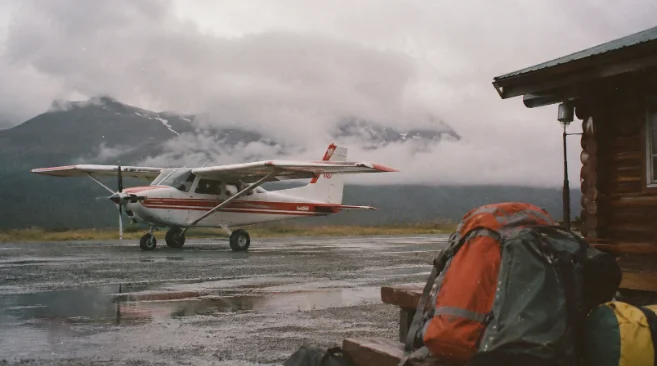
Floatplanes and aircraft equipped for remote airstrips are commonly used to reach isolated wilderness destinations.
Aircraft selection depends on the operator, destination and local conditions. The pilot and air operator determine whether a flight can proceed safely.
Do not independently arrange a charter without discussing it with your outfitter. The transportation plan needs to account for camp availability, personnel, baggage and the wider expedition schedule.
Building an Itinerary That Can Handle Delays
Weather-related delays are a normal consideration when organizing remote northern travel. A carefully planned itinerary should accommodate reasonable disruptions without immediately creating conflicts with accommodation, charter arrangements or your return flight.
Arrival buffers
For most travellers, arriving in Whitehorse approximately two nights before the scheduled departure into camp provides a practical starting point.
Several Yukon outfitters recommend allowing additional time for delayed commercial flights, missing luggage and final preparations.
The number of connecting flights and the flexibility of your charter schedule both influence how much buffer time to allow in Whitehorse before your hunt begins.
A direct morning flight may justify a shorter buffer if your outfitter agrees. A complicated itinerary involving separate airline bookings or infrequent regional services may warrant an additional night.
Return buffers
The scheduled end of your hunt is not necessarily the day you will return to Whitehorse.
Low cloud, poor visibility, wind and other weather conditions can affect bush flights even when commercial aircraft are operating normally elsewhere in the territory.
Allowing two complete contingency days after your scheduled return from camp is a sensible planning option for many remote expeditions. Some outfitters may recommend a longer margin depending on the location and season.
Matching your bookings to the outfitter’s schedule
Consider a hypothetical ten-day hunt with separate travel days. You arrive in Whitehorse on the first day, spend the following day preparing, and transfer into camp on Day 3. Your ten scheduled hunting days occupy Days 4 through 13, with a planned return from camp on Day 14.
Two further contingency days would place your commercial departure on Day 17.
The exact itinerary will depend on your agreement, but this example illustrates why booking only ten or fourteen days away from home can leave insufficient flexibility.
Confirm the actual travel dates in writing before purchasing non-refundable tickets.
Understanding the True Travel Cost
The advertised price of a guided Yukon hunt may cover a substantial portion of the expedition, but it does not necessarily include every cost associated with reaching the camp and returning home.
Separating transportation expenses from the hunt package makes budgeting considerably easier.
Commercial flights and charter arrangements
Start by establishing whether the outfitter’s quoted price includes the scheduled charter into and out of camp.
Some packages include remote transportation, while others charge for aircraft services separately. Additional flights outside the scheduled arrangements may also be treated differently.
Request clarification about possible charges for baggage, extra aircraft movements and transportation changes caused by delays.
Currency deserves attention as well. Yukon outfitters serve international clients, and some quote their prices in US dollars. Confirm whether each amount is expressed in CAD or USD before calculating your overall budget.
Accommodation, meals and ground transportation
Budget separately for expenses incurred outside the hunting camp.
These may include hotel accommodation in Whitehorse, restaurant meals, airport transfers, onward transportation and luggage storage.
Confirm whether the outfitter makes accommodation reservations on your behalf or simply recommends particular hotels.
If you intend to bring harvested meat or wildlife parts home, investigate transportation arrangements, processing requirements and applicable documentation in advance. The Government of Yukon establishes export requirements for wildlife parts, and your outfitter can help clarify which documents apply to your circumstances.
A contingency reserve for unexpected expenses
Rather than selecting an arbitrary emergency budget, calculate your reserve using costs that apply to your itinerary.
Obtain estimates for several additional hotel nights, alternative transportation, airline fare differences and necessary replacement purchases.
The reserve should reflect expenses you could reasonably encounter if the expedition takes longer than planned. Keep it separate from discretionary spending and do not assume that insurance will reimburse every unexpected expense.
Packing for Two Very Different Types of Flight
Packing for a fly-in expedition requires meeting two sets of transportation requirements: those of your commercial airline and those of the remote aircraft operator.
A bag accepted on your flight into Whitehorse may be too heavy, too large or otherwise unsuitable for the charter into camp.
Commercial airline baggage requirements
Commercial carriers publish baggage allowances according to their routes, aircraft and applicable fare conditions.
Air North, for example, distinguishes between baggage arrangements on different aircraft and services. Review the requirements for every flight on your itinerary, especially if you are travelling beyond Whitehorse on a regional service.
Items such as spare lithium batteries, power banks and regulated equipment are subject to additional transportation requirements. Consult CATSA, Transport Canada and your individual carriers before packing them.
Weight restrictions on the final flight
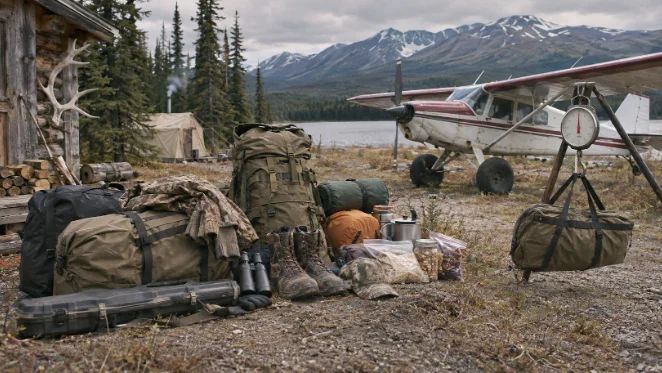
Small aircraft have limited carrying capacity. The permitted load depends on passenger weights, fuel, baggage, aircraft configuration and operating conditions.
Some Yukon outfitters specify personal equipment allowances around 27 kg (60 lb), while others use different limits according to the expedition.
It is worth working through the practical details of packing within bush plane weight limits before purchasing equipment that may never make it into camp.
Obtain your actual allowance directly from the outfitter and respect any final restrictions imposed by the air operator.
Leaving unnecessary luggage in town
Casual clothing, large suitcases and items intended exclusively for the return journey can often remain in Whitehorse.
Arrange secure storage in advance, and confirm that you will be able to retrieve your belongings if your return date changes.
What Life in a Remote Hunting Camp Is Like
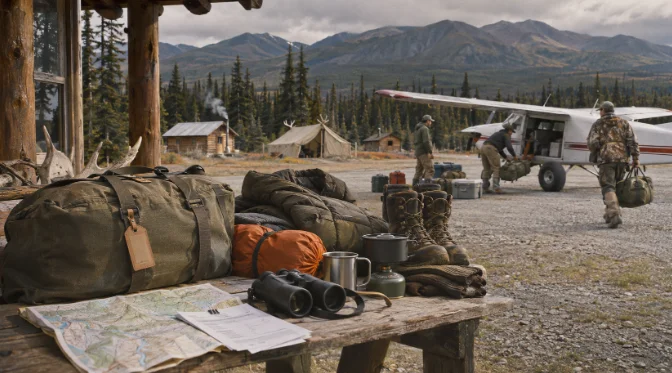
A Yukon hunting camp can range from a comfortable wilderness cabin to a basic temporary shelter with few facilities.
The experience depends on the concession, season, camp location and expedition arrangements. Photographs of a well-equipped base camp should not be treated as a guarantee that every night will be spent in similar accommodation.
Accommodation and daily routines
Established camps may provide beds, heating, cooking facilities and communal dining areas. Some also have showers, electricity and satellite internet.
More remote camps generally operate with fewer conveniences. Daily routines are influenced by weather, available daylight, transportation arrangements and the activities planned by your guide.
Expect a greater degree of flexibility than you would on a conventional holiday. Meal times may vary, personal space can be limited, and opportunities to wash clothing or recharge equipment may be infrequent.
Discuss dietary requirements, medical considerations and accommodation needs before departure. Replacing forgotten supplies or resolving special requests can be difficult once you are several hours from the nearest community.
Limited electricity and communication
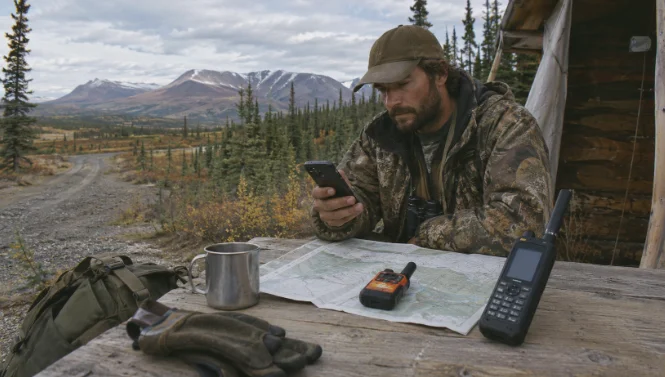
Mobile phone coverage is unavailable across much of the Yukon wilderness. Some established camps provide satellite internet, but smaller temporary camps may have no ordinary internet access.
Your phone may remain useful long after it loses its cellular signal, provided you have prepared for the realities of staying connected in the Yukon backcountry.
Download important documents, maps and personal reading materials before leaving town.
Ask your outfitter whether the camp provides charging facilities, whether guests can use them and what emergency communication equipment is available. Do not assume that a satellite internet connection at the main lodge extends to every camp in the concession.
Rest days and weather interruptions
Not every day of an expedition will follow the original schedule. Poor visibility, heavy rain, early snowfall or other conditions may restrict transportation and outdoor activities.
A little preparation for what to do during weather delays on a Yukon hunt can make the quieter parts of an expedition more comfortable without adding much weight to your luggage.
Reading, journalling, resting and attending to personal equipment can provide useful ways to spend an unexpected day in camp.
These interruptions are not necessarily evidence of poor planning. An experienced guide or pilot may decide that waiting is the most responsible course of action.
Insurance, Responsibilities and Emergency Planning
The remoteness of a fly-in Yukon hunt changes the consequences of relatively ordinary travel problems.
A missed flight, medical issue or transportation disruption can involve several organizations, each operating under different contractual arrangements.
What your outfitter is responsible for
Review your written agreement carefully rather than relying exclusively on discussions or promotional material.
Establish which transportation services, accommodation, meals, equipment and professional guiding arrangements are included.
Pay particular attention to contractual provisions covering weather delays, cancellation, early departure, additional aircraft movements and medical emergencies.
An outfitter may coordinate transportation without assuming financial responsibility for every disruption affecting your wider journey.
Understanding these distinctions before departure is considerably easier than resolving disagreements from a remote camp.
What your travel insurance may not cover
Canadian travellers sometimes assume that travelling within Canada eliminates the need for additional medical coverage.
Health Canada explains that provincial and territorial public insurance plans cover eligible medically necessary hospital and physician services, but other expenses, including ambulance services, are not necessarily covered on the same basis outside your home province or territory.
A wilderness expedition introduces additional considerations.
When reviewing insurance, distinguish between:
- Trip cancellation: eligible circumstances that prevent you from beginning your trip.
- Trip interruption: eligible circumstances that disrupt an expedition already underway.
- Emergency medical coverage: specified medical expenses incurred while travelling.
- Medical evacuation: transportation to an appropriate medical facility when covered by the policy.
- Search and rescue coverage: expenses associated with locating or rescuing a person, where applicable.
Do not assume that wilderness evacuation and search and rescue are automatically included in a standard medical insurance policy.
Ask the insurer to confirm in writing whether guided hunting, remote aircraft transportation and your intended activities are covered. Check exclusions, deductibles, pre-existing condition provisions and emergency authorization requirements.
Making sure someone knows your itinerary
The Government of Yukon recommends leaving a detailed wilderness trip plan with a responsible contact.
For a guided expedition, that plan should include your outfitter’s contact information, anticipated travel dates, known staging locations, communication arrangements and an agreed overdue deadline.
Your contact should understand that routine messages may be delayed, but also know when and how to seek assistance.
Confirm that you and your outfitter have appropriate emergency communication arrangements. Emergency evacuation from remote country may be affected by weather, distance and aircraft availability, even after assistance has been requested.
Who Is Responsible for Each Part of the Journey?
The following table provides a practical starting point for understanding how responsibilities may be divided during a typical guided fly-in expedition.
| Responsibility | Hunter | Outfitter | Carrier |
|---|---|---|---|
| Commercial flight booking | Usually arranges | May provide guidance | Operates commercial flights |
| Camp transfer | Confirms arrangements | Usually coordinates | Operates transportation |
| Personal equipment | Supplies required items | Provides equipment guidance | Establishes transport restrictions |
| Weather-related flight decisions | Follows instructions | Coordinates itinerary changes | Pilot or operator determines flight safety |
| Insurance | Obtains and verifies coverage | May specify requirements | Responsibilities depend on applicable terms |
| Camp communications | Establishes personal contact plan | Explains available facilities | Generally not responsible |
This allocation is illustrative. Your actual responsibilities depend on the contract, transportation arrangements and applicable regulations.
Canada’s Air Passenger Protection Regulations provide certain protections when qualifying flights are disrupted. However, disruptions outside an airline’s control, including weather-related safety issues, do not generally create an entitlement to compensation for inconvenience or mandatory hotel and meal assistance.
Commercial passenger protections should not be assumed to cover losses arising from an independently arranged wilderness transfer.
A Practical Planning Timeline
Preparing for a fly-in Yukon hunt becomes more manageable when decisions are made in the right order.
Six to twelve months before departure
By this stage, you should ideally have confirmed your outfitter, expedition dates and accommodation arrangements. Particularly sought-after hunts may need to be booked much earlier.
Review the transportation plan, equipment requirements and payment schedule. Investigate insurance while you still have time to compare policies and understand any deadlines associated with cancellation coverage.
Begin preparing physically for the anticipated demands of the expedition and resolve questions about medical needs or other personal requirements.
One to three months before departure
Confirm commercial flights, accommodation and ground transportation using the dates supplied by your outfitter.
Review current Government of Yukon licensing requirements and ensure that any necessary documents will be available before departure.
Complete your major equipment purchases, test personal electronics and establish your communication arrangements.
Check baggage requirements for both commercial and charter flights.
The final week
Pack and weigh your complete luggage, including bags and personal accessories.
Download offline documents, maps and entertainment. Test communication devices and confirm that any required subscriptions are active.
Provide your designated contact with the final itinerary and confirm your outfitter’s arrival instructions.
Check weather information and transportation updates, but avoid making independent changes to remote travel arrangements without consulting the outfitter.
Are You Ready for a Fly-In Yukon Hunt?
Before leaving home, make sure you can confidently answer the following questions:
- Do you know your exact meeting location and required arrival time?
- Have you allowed sufficient contingency days before and after the expedition?
- Are your commercial and charter transportation arrangements confirmed?
- Do you understand which expenses are included in the hunt price?
- Does your equipment meet the confirmed baggage requirements?
- Have you verified your insurance and emergency evacuation arrangements?
- Can you communicate essential information without conventional cellular coverage?
- Does someone know your itinerary and when to seek assistance?
- Have you confirmed applicable licensing and documentation requirements?
A well-planned Yukon expedition does not require predicting every possible disruption. It requires understanding which arrangements are fixed, which can change and what you will do when the unexpected happens.
Build flexibility into your travel dates, make your responsibilities clear and prepare for the conditions you are likely to encounter. Once those details are settled, you can devote considerably more attention to the wilderness experience that brought you north in the first place.